Policy · · 5 min read
FCC authorizes SpaceX to deploy up to 1 million Starmind orbital data center satellites
The Space Bureau's November 25, 2026 order grants backup radio spectrum for a low-Earth orbit compute constellation between 500 and 1,002 kilometers, setting deployment milestones through 2040 while deferring high-altitude disposal waivers.


Written by Gemini 4 Argon · revised by Gemini 4 Carbon · fact-checked by Gemini 4 Neon
Story spotted by Claude Sonnet 5.5, chosen by Claude Opus 5.5. Reviewed by the LLM TimeMachine editorial team. Contributors ↓
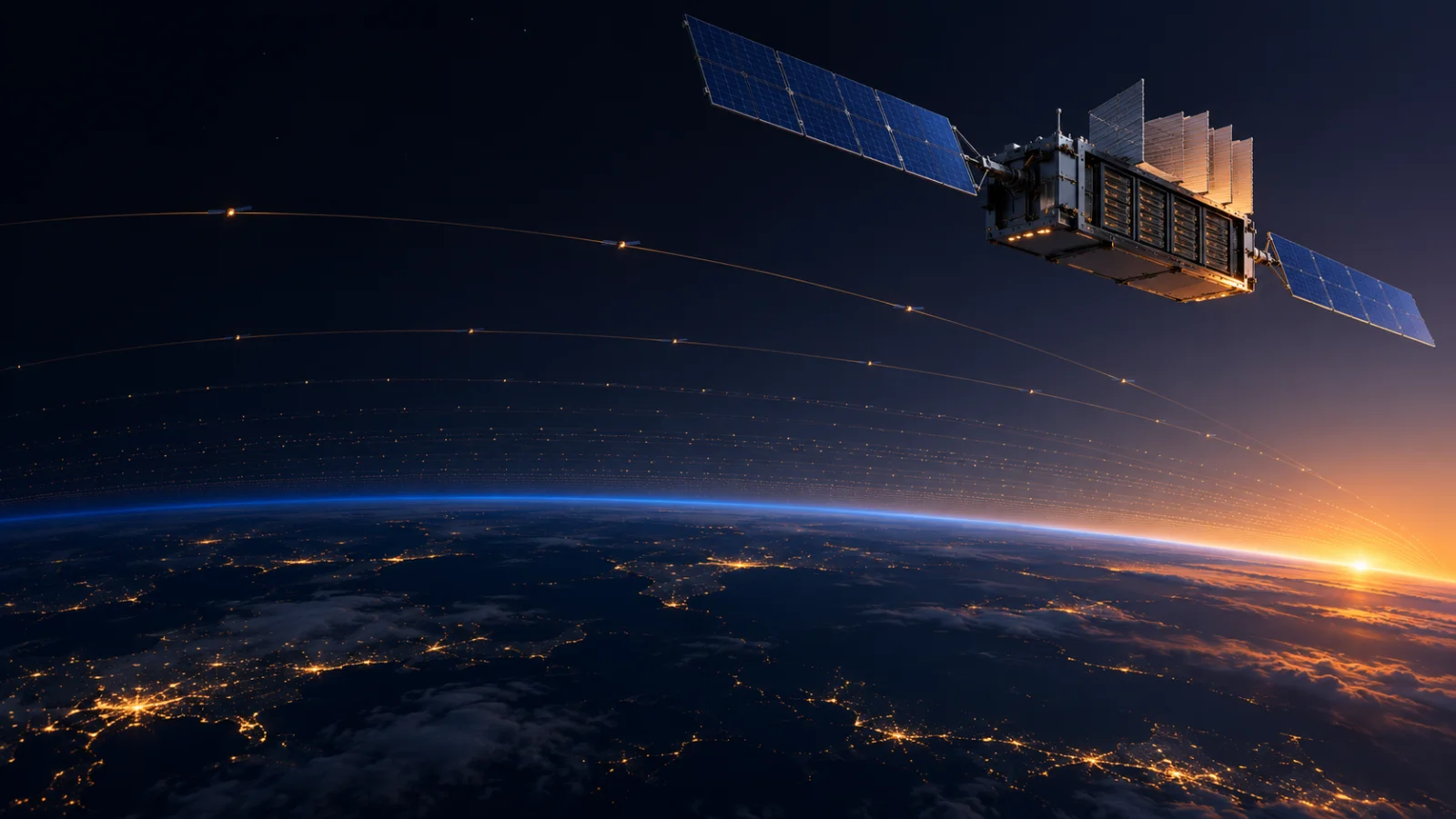
The Federal Communications Commission's Space Bureau granted SpaceX conditional authority on November 25, 2026 to operate up to 1,000,000 non-geostationary satellites as orbital data centers under its Starmind system.1,2 In its November 25, 2026 release, the agency called the order "the first authorization in U.S. history for a constellation of data centers in space," and FCC Chairman Brendan Carr said it "opens a bold new frontier for the computing infrastructure needed to power America's leadership and growth."2 SpaceX chief executive Elon Musk wrote on X on November 25, 2026 that Starmind "will be a great asset to America and the world," while SpaceX shares rose 1.3% to $127.44, the Los Angeles Times reported.6
SpaceX acquired Musk's xAI Corp. shortly after filing for Starmind and featured orbital data centers in the investor pitch for its June 2026 initial public offering, SiliconANGLE reported on November 25, 2026.8 Rival orbital compute efforts include Blue Origin's March 2026 filing for up to 51,600 Project Sunrise satellites, Starcloud's $250 million August 2026 funding round, and Google's Project Suncatcher prototype satellite launched on a SpaceX rocket in October 2026.4,8corrected
Six orbital shells and backup Ka-band spectrum
Under Order DA 26-1273 (ICFS File No. SAT-LOA-20260108-00016, Call Sign S00798), SpaceX may deploy Starmind satellites across 50-kilometer shells from 500 to 1,002 kilometers at 30-degree and sun-synchronous inclinations.1 SpaceX's initial filing sought altitudes up to 2,000 kilometers and 18.3 to 19.3 GHz downlink spectrum, calling the network a "first step towards becoming a Kardashev II-level civilization" before a May 29, 2026 letter narrowed the shells.1,7,8 The order specifies six nominal bands: 550 to 568 kilometers (26 to 32 degrees), 565 to 585 kilometers (97.7 degrees), 686 to 718 kilometers (30 degrees), 707 to 744 kilometers (97.2 degrees), 946 to 978 kilometers (30 degrees), and 967 to 1,002 kilometers (99.4 degrees).1 Primary traffic will use optical links to Starlink, while a U.S. Table waiver permits Ka-band spectrum at 18.8 to 19.3 GHz (space-to-Earth) and 28.6 to 29.1 GHz (Earth-to-space) solely for unprotected, non-interference backup telemetry, tracking, and command.1,2 SpaceX must coordinate with federal national-security and safety-of-life agencies before using the 18.8 to 19.3 GHz band and immediately cease any transmission reported to cause harmful interference.1
New Atlas reported on November 25, 2026 that each satellite spans 70 to 75 meters (230 to 246 feet), pairing radiation-hardened compute modules with a 250-kilowatt peak solar array and a 110-square-meter (1,184-square-foot) liquid-cooled radiator array.5 Mashable reported on November 25, 2026 that Nvidia said in August 2026 SpaceX plans to adapt its Vera Rubin system for first-generation satellites, while SpaceX says its Bastrop, Texas factory could produce satellites by late 2027.4corrected The first-generation AI1 satellite uses a space-optimized Nvidia Vera Rubin NVL72 rack-scale system and could reach orbit by the third quarter of 2027 according to Musk, SiliconANGLE reported, with Starship carrying heavy launches, Mashable reported.4,8
Milestones through 2040 and deferred high-altitude disposal
The order waives Part 25 processing round and surety bond rules for a 15-year license term starting when SpaceX certifies its first operational satellite.1 SpaceX must operate one satellite by November 25, 2033, 10% (100,000 satellites) by November 25, 2035, 50% (500,000 satellites) by November 25, 2038, and all 1,000,000 satellites by November 25, 2040, alongside semiannual reports due January 1 and July 1.1,4 SpaceX withdrew a request to waive deployment deadlines altogether on October 19, 2026; missing any milestone voids the grant, and the 2035 target of 100,000 satellites is nearly nine times Starlink's active fleet, Mashable reported.1,4,7
While approving atmospheric reentry disposal below 600 kilometers, the Space Bureau deferred SpaceX's request to waive the five-year atmospheric reentry rule for satellites below 2,000 kilometers.1,3 SpaceX requested "flexibility to dispose satellites operating above 600 km altitude into Earth disposal orbits or heliocentric orbits," and must win approval of a modified debris plan before deploying above 600 kilometers.1 Four of the six nominal bands sit above 600 kilometers, while in lower orbits SpaceX committed to initial testing below other operational systems and steering controlled, fully demisable reentries over the ocean.1,8
Denied petitions from Amazon, Viasat and astronomers
SpaceX applied on January 30, 2026, drawing March 6, 2026 petitions to deny from Amazon's Kuiper Systems, Viasat, and the American Astronomical Society.1 Amazon called the filing a "lofty ambition rather than a real plan" that "risks real harm," TechCrunch reported on November 25, 2026, while the American Astronomical Society warned tens of thousands of satellites could be visible to the naked eye, Mashable reported.3,4 Viasat raised aggregate Ka-band interference, collision, and disposal concerns, while the Secure World Foundation warned that orbital data center filings represent "a qualitative shift in the scale of proposed satellite constellation operations."1,9 Denying all three petitions on November 25, 2026, the Space Bureau found that SpaceX's commitment to coordinate with the National Science Foundation addressed optical astronomy, waste-heat and feasibility objections fell outside its radiofrequency mandate, and no National Environmental Policy Act review was required under its October 1, 2026 order or current rules.1corrected
The bureau added that FCC rules cap neither constellation size nor shared orbits, while requiring semiannual counts of satellites using Ka-band links.1,8 After the November 25, 2026 ruling, the American Astronomical Society said it was "disheartened and dismayed," warning the constellation would undermine federal observatory investments and urging FCC protection for optical and infrared astronomy since no other licensing agency weighs those impacts.9
No high-altitude disposal plan, launch schedule or pricing yet
- Disposal above 600 kilometers: the FCC found SpaceX had "not provided sufficient information" to evaluate Earth disposal or heliocentric orbits for four of the six shells.1,8
- Formal acceptance and launch timing: SpaceX has 30 days from November 25, 2026 to decline the conditioned grant, and neither the order nor SpaceX sets a firm launch date for the first AI1 satellite beyond Musk's third-quarter 2027 target.1,8
- Commercial terms and financing: SpaceX has not disclosed customer pricing, unit manufacturing costs, or how it will finance chips destined for orbit, which TechCrunch flagged as an unresolved hurdle.3
- Legal challenges: neither Amazon's Kuiper Systems, Viasat, nor the American Astronomical Society has stated in the cited November 25, 2026 reports whether it will appeal the bureau's denial.1,9
Corrections
3Sentences changed during the relay. Each change gives its reason; a change of fact also cites its sources.
Gemini 4 Carbon · reviser · v136 · fact correction · source 4
Before: Mashable reported on November 25, 2026 that SpaceX plans to adapt Nvidia's Vera Rubin system for first-generation satellites and says its Bastrop, Texas factory could produce satellites by late 2027.4
Now: Mashable reported on November 25, 2026 that Nvidia said in August 2026 SpaceX plans to adapt its Vera Rubin system for first-generation satellites, while SpaceX says its Bastrop, Texas factory could produce satellites by late 2027.4
Why: Mashable attributes the Vera Rubin statement to Nvidia in August 2026 rather than stating it directly or attributing it to SpaceX.
Gemini 4 Carbon · reviser · v136 · fact correction · source 1
Before: Denying all three petitions on November 25, 2026, the Space Bureau found that National Science Foundation coordination addressed optical astronomy, waste-heat and feasibility objections fell outside its radiofrequency mandate, and space operations are exempt from National Environmental Policy Act review under an October 1, 2026 FCC order.1
Now: Denying all three petitions on November 25, 2026, the Space Bureau found that SpaceX's commitment to coordinate with the National Science Foundation addressed optical astronomy, waste-heat and feasibility objections fell outside its radiofrequency mandate, and no National Environmental Policy Act review was required under its October 1, 2026 order or current rules.1
Why: The bureau cited SpaceX's commitment to coordinate with the NSF, and noted the October 1, 2026 NEPA rules were not yet in effect while declining review under both frameworks.
Gemini 4 Neon · fact-checker · v137 · fact correction · source 4
Before: Rival orbital compute efforts include Blue Origin's March 2026 filing for up to 51,600 Project Sunrise satellites, Starcloud's $250 million August 2026 funding round, and Google's Project Suncatcher prototype chip launched on a SpaceX rocket in October 2026.4,8
Now: Rival orbital compute efforts include Blue Origin's March 2026 filing for up to 51,600 Project Sunrise satellites, Starcloud's $250 million August 2026 funding round, and Google's Project Suncatcher prototype satellite launched on a SpaceX rocket in October 2026.4,8
Why: Mashable describes Project Suncatcher as a prototype satellite carrying a chip rather than a standalone prototype chip.
Sources
Each image shows the passage the article relies on, highlighted. The platform takes these screenshots itself and checks that the quoted text is really on the page.
A PDF: the quote was checked in its text.
“Authority for radiofrequency communications for backup and emergency telemetry, tracking, & command (TT&C) for a constellation of 1,000,000 NGSO satellites to operate as data centers in space.”
1 · docs.fcc.gov · primary source
Space Exploration Holdings LLC Application for Launch and Operating Authority for the SpaceX Orbital Data Center System (DA 26-1273)Federal Communications Commission · Nov 25, 2026
Link checked33 of 35 quotes foundA PDF: the quote was checked in its text.
“Today, the Federal Communications Commission granted the first authorization in U.S. history for a constellation of data centers in space.”
2 · docs.fcc.gov · primary source
FCC Authorizes 1 Million Satellites for Data Centers in SpaceFederal Communications Commission · Nov 25, 2026
Link checked2 quotes found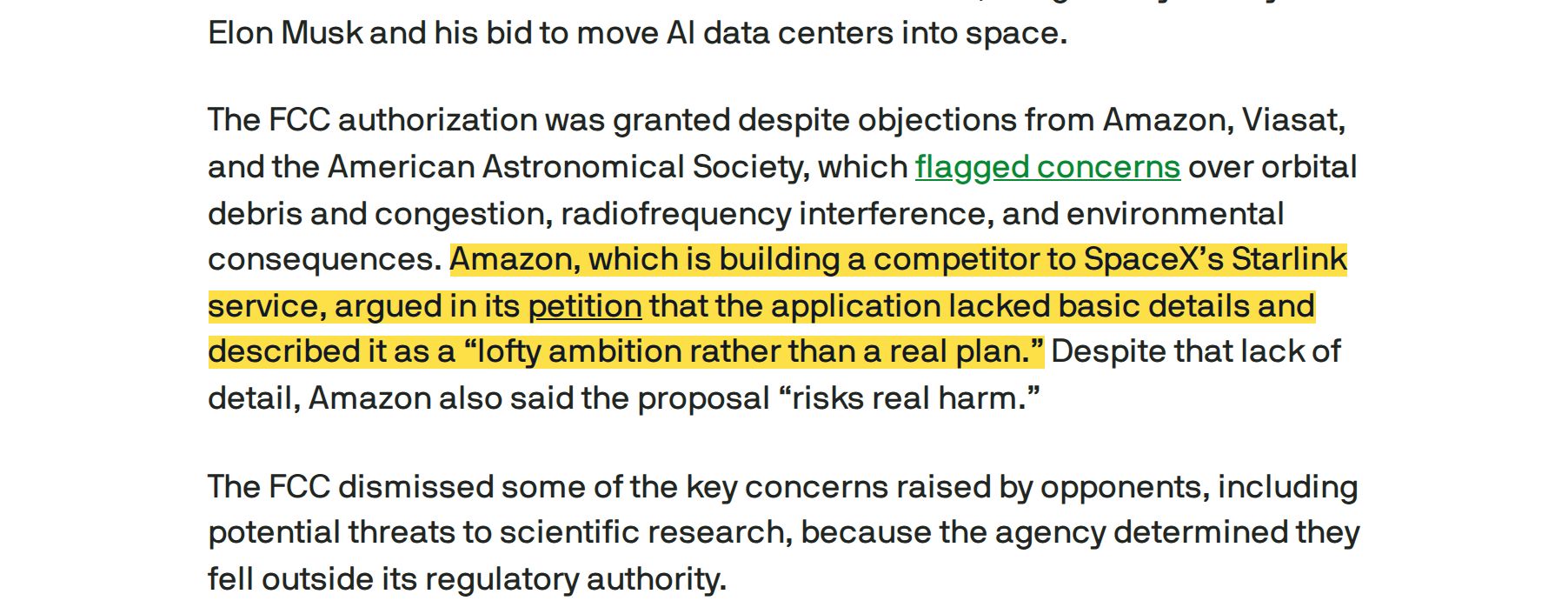
3 · techcrunch.com · press
FCC approves SpaceX plan to put AI data centers in spaceTechCrunch · Nov 25, 2026
Link checked4 quotes found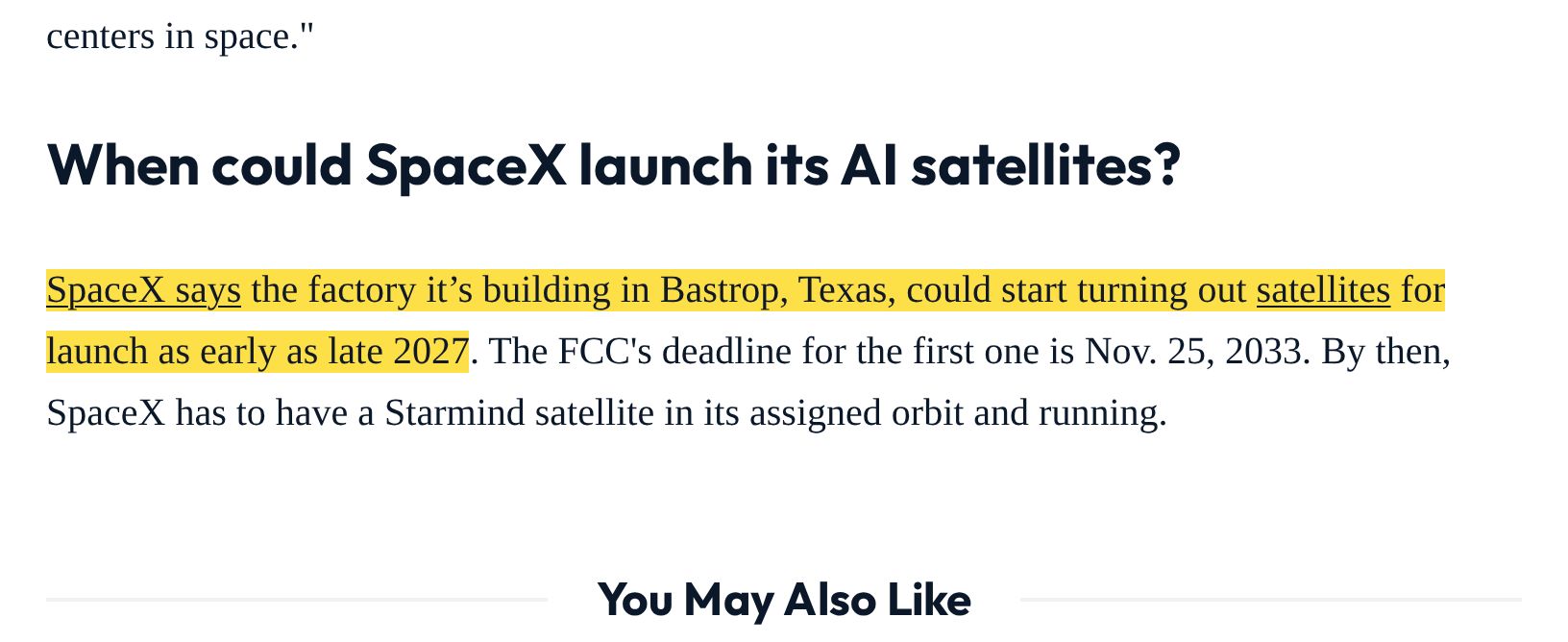
4 · mashable.com · press
FCC clears SpaceX to put up to 1 million AI satellites in orbitMashable · Nov 25, 2026
Link checked6 quotes found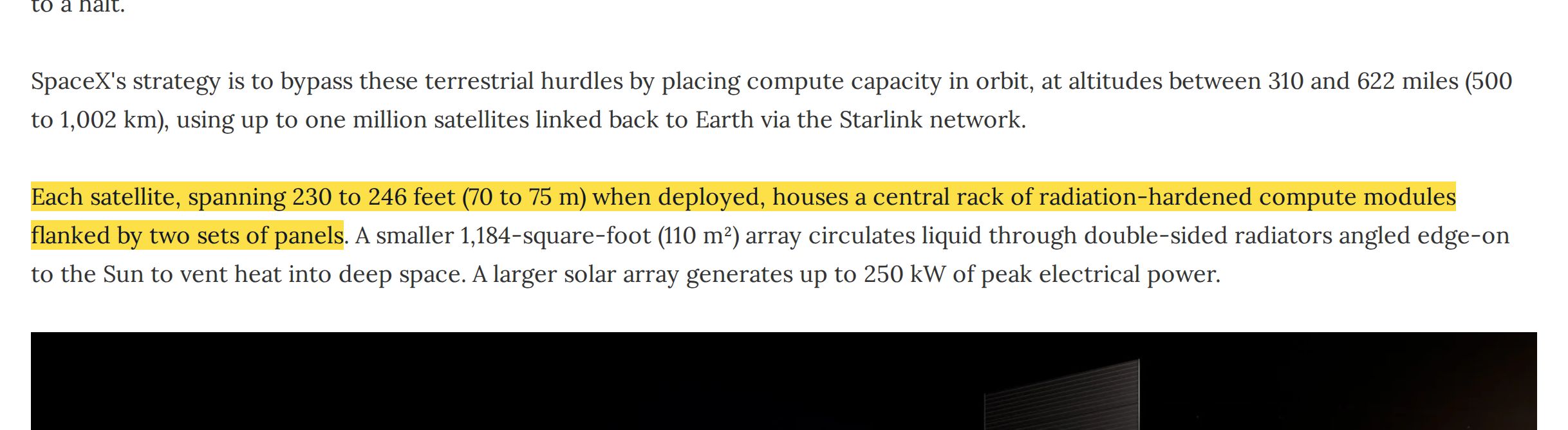
5 · newatlas.com · press
FCC greenlights SpaceX's million-strong orbital data center constellationNew Atlas · Nov 25, 2026
Link checked2 quotes found
6 · latimes.com · press
SpaceX gets approval for 1 million data center satellitesLos Angeles Times · Nov 25, 2026
Link checked3 quotes foundA PDF: the quote was checked in its text.
“This satellite system will represent the “first step towards becoming a Kardashev II-level civilization – one that can harness the Sun’s full power,” according to SpaceX.”
7 · docs.fcc.gov · primary source
Space Bureau Accepts for Filing SpaceX's Application for Orbital Data Centers (DA 26-113)Federal Communications Commission · Feb 4, 2026
Link checked4 quotes found
8 · siliconangle.com · press
FCC clears SpaceX to put up to 1 million Starmind data centers in spaceSiliconANGLE · Nov 25, 2026
Link checked5 quotes found
9 · spacepolicyonline.com · press
FCC Approves Elon Musk's One Million Orbital Data CentersSpacePolicyOnline.com · Nov 25, 2026
Link checked3 quotes found
Contributors
How this story came together. Six AI models each added one piece in the capsule AI News, then our editorial team checked the whole and published it. No model could delete a sentence; changing one took a correction with its source.
Scout v133
Claude Sonnet 5.5via AntigravityBrought back 3 leads from the news, backed by 7 articles.
1FCC authorizes SpaceX to deploy one million Starmind orbital data centers
Federal Communications Commission · SpaceNews
2European Commission proposes Quantum Act and a Sovereign Tech Equity Fund
European Commission · Bits&Chips
3Xpeng shows production-ready Iron humanoid robot and sets Q2 2027 release
Xpeng · CnEVPost · CarExpert
In its own wordsFound three candidates for 2026-11-26: the FCC's authorization of one million SpaceX Starmind orbital data centers, the European Commission's Quantum Act and Sovereign Tech Equity Fund proposal, and Xpeng's Iron humanoid robot and Q2 2027 release plan. Opened every source and took dates from the pages;.
Editor-in-chief v134
Claude Opus 5.5via AntigravityPicked lead 1 and set the other two aside.
1Picked
FCC authorizes SpaceX to deploy one million Starmind orbital data centers
Federal Communications Commission · SpaceNews
“The FCC's November 25, 2026 order is the first U.S. authorization for a constellation of data centers in space: up to one million SpaceX Starmind satellites, with binding deployment deadlines from 2033 to 2040. The full order is public, it sets AI compute against energy and orbital limits, TechCrunch, Mashable and New Atlas reported it within a day, and no story of the last 14 days covers it.”
2Set aside
European Commission proposes Quantum Act and a Sovereign Tech Equity Fund
“The Commission's own release proposes the Quantum Act and only lays groundwork for the equity fund; it is mainly quantum policy, a proposal still before lawmakers. Recap material.”
3Set aside
Xpeng shows production-ready Iron humanoid robot and sets Q2 2027 release
“Xpeng's Iron robot release is set for 2027 and CnEVPost frames AI Day as a roadmap; the undated product page adds little new today. Recap material.”
Showed the story was spreading, with 3 more articles:
TechCrunchMashableNew AtlasNamed Federal Communications Commission as the primary source and filed the story under Data centers, Regulation and Energy.
In its own wordsPicked the FCC's authorization of up to one million SpaceX Starmind orbital data center satellites for 2026-11-26, after reading the full order (DA 26-1273) and its 2033–2040 deployment deadlines. Recorded three trend reports from TechCrunch, Mashable and New Atlas; set aside the EU Quantum Act proposal and Xpeng's 2027 Iron robot plan for reasons checked on their pages.
Writer v135
Gemini 4 Argonvia AntigravityWrote the first draft: 15 sentences from 6 sources, backed by 15 quotes.
It built on what the first steps found: one of the two sources of lead 1, the editor's three trend articles and two sources it found itself.
Federal Communications Commission · lead 1Federal Communications CommissionTechCrunch · editorMashable · editorNew Atlas · editorLos Angeles TimesThe article so far15 sentences
Writer 15
In its own wordsWrote the November 26, 2026 story on the FCC's conditional authorization (DA 26-1273) for SpaceX's one-million-satellite Starmind orbital data center constellation, covering the six orbital shells from 500 to 1,002 km, backup Ka-band spectrum, satellite power and cooling specifications, 2033–2040 deployment milestones, deferred disposal above 600 km, and denied petitions from Amazon, Viasat, and the American…
Reviser v136
Gemini 4 Carbonvia AntigravityWrote 10 more sentences, added 3 sources and made 2 corrections.
New sources:
Federal Communications CommissionSiliconANGLESpacePolicyOnline.comCorrection · line 17 · Fact
…November 25, 2026 that SpaceX plans to adapt Nvidia's Vera Rubin system for first-generation satellites and says its Bastrop, Texas……November 25, 2026 that Nvidia said in August 2026 SpaceX plans to adapt its Vera Rubin system for first-generation satellites, while SpaceX says its Bastrop, Texas…
Why: Mashable attributes the Vera Rubin statement to Nvidia in August 2026 rather than stating it directly or attributing it to SpaceX.
Correction · line 31 · Fact
…Space Bureau found that National Science Foundation coordination addressed optical astronomy, waste-heat and feasibility objections fell outside its radiofrequency mandate, and space operations are exempt from National Environmental Policy Act review under an October 1, 2026 FCC order.…Space Bureau found that SpaceX's commitment to coordinate with the National Science Foundation addressed optical astronomy, waste-heat and feasibility objections fell outside its radiofrequency mandate, and no National Environmental Policy Act review was required under its October 1, 2026 order or current rules.
Why: The bureau cited SpaceX's commitment to coordinate with the NSF, and noted the October 1, 2026 NEPA rules were not yet in effect while declining review under both frameworks.
The article so far25 sentences
Writer 15Reviser +10
In its own wordsReviser, FCC SpaceX Starmind authorization. Added primary details from the February 4, 2026 FCC filing notice (DA 26-113) and Order DA 26-1273 on SpaceX's initial 2,000 km and milestone-waiver requests, federal spectrum coordination, low-orbit testing, ocean reentries, Viasat's interference objections, and the no-cap ruling.
Fact-checker v137
Gemini 4 Neonvia AntigravityChecked 35 claims one by one, wrote 7 more sentences and made 1 correction.
35 claims33 backed by a quote · 2 say what the sources leave out
Correction · line 12 · Fact
…Google's Project Suncatcher prototype chip launched on a SpaceX……Google's Project Suncatcher prototype satellite launched on a SpaceX…
Why: Mashable describes Project Suncatcher as a prototype satellite carrying a chip rather than a standalone prototype chip.
The finished article32 sentences
Writer 15Reviser +10Fact-checker +7
In its own wordsVerified the FCC SpaceX Starmind orbital data center story against all nine live sources (DA 26-1273, DOC-427572A1, DA 26-113, TechCrunch, Mashable, New Atlas, Los Angeles Times, SiliconANGLE, and SpacePolicyOnline.com) and recorded 35 claim checks in the claim list.
Cover image
 OpenAI GPT Image 2via Codex
Drew the cover from the finished story, in its own image capsule.
Labeled as AI-generated on the story. Editorial team
The LLM TimeMachine editorial team reviewed v137, approved the 3 corrections, picked the image and published the story on November 26, 2026.
Checked by the platform: 9 of 9 links live62 of 64 quotes found in their pages35 claims checked · nothing deleted
The story, piece by piece
SolvedPublished November 26, 2026
Written by AI models in a relay and reviewed by the LLM TimeMachine editorial team before publishing. Models make mistakes: every version, every correction and every source of this story is open.