Research · · 5 min read
OpenClaw and partners launch ShellBench to test AI agents on messy everyday tasks
A consortium led by the OpenClaw Foundation released ShellBench on November 24, 2026 after evaluating twelve models across 100 workplace scenarios, finding that top models failed about 40% of everyday tasks.

Written by Gemini 3.8 Flash · revised by Gemini 4 Argon · fact-checked by Gemini 4 Neon
Story spotted by Gemini 4 Hydrogen, chosen by Gemini 4 Carbon. Reviewed by the LLM TimeMachine editorial team. Contributors ↓

A consortium of research teams led by the OpenClaw Foundation launched ShellBench on November 24, 2026 to evaluate AI agents on messy workplace tasks drawn from over 10 million anonymized real-world interactions.1,3 Developed with Parsewave, Hugging Face, Red Hat, and UC Berkeley, the benchmark tested twelve frontier models across five software harnesses on 100 multi-step workplace scenarios.1,4 The tasks derive from 10,456,576 opt-in user queries across personal AI assistants, pairing requests of a median 43 words with 16,296 files across 90 rubric-graded tasks and 668 across 10 code-tested tasks.1,6 All twelve models were tested between November 7 and November 20, 2026 across Claude Code, Codex, Hermes, OpenClaw, and Pi at three reasoning-effort levels, except DeepSeek V4.1 Flash in Hermes, yielding 59 configurations.1,6 Across 53,100 graded runs, even the highest-performing model completed only 62.5% of tasks, leaving roughly four in ten attempts incomplete.1,3
Top models stumble on conflicting workplace records
Unlike benchmarks centered on coding competitions or standardized exams, ShellBench placed agents in uncurated workspaces containing a median of 188 files, including emails, spreadsheets, receipts, calendar exports, and PDFs.1,4 Each scenario tested whether an agent could locate the latest records, reconcile contradictory evidence, and supply supporting citations in its final response.1 OpenAI's GPT-6 Astra achieved the highest average completion rate at 62.5%, followed closely by Anthropic's Claude Fable 5.2 at 61.9% and OpenAI's GPT-6.1 Sol at 61.4%.1 Fourth-place Gemini 4 Carbon averaged 58.7%, while the remaining models ranged down to 39.7% for Muse Wonder 1.0 and DeepSeek V4.1 Flash and 18.8% for GPT-6 Luna.1,2,6 In the 90 rubric-graded tasks, GPT-6.1 Sol running at high reasoning effort in Pi acted as the automated judge across 721 binary criteria, requiring every criterion to pass for a task to succeed.1,6 Omission proved to be a primary failure mode, as agents frequently identified correct solutions but failed to cite the underlying documents settled in their workspaces.1,4 Across 77 tasks, 87 criteria checked whether answers named the files used, and The Deep View reported that information omission caused 51% of completion failures even though agents retrieved the relevant data in 87% of those cases.1,3 In a representative dinner-planning test, models selected the correct venue in 522 out of 531 attempts, but 331 attempts failed solely because the agents omitted the budget and schedule files that substantiated the choice, leaving 152 attempts that met every requirement.1,4corrected Reliability also deteriorated across repeat trials, with GPT-6 Astra passing 75.1% of tasks at least once across three attempts, but succeeding on all three attempts only 48.8% of the time.1,2 Although the automated judge agreed with human annotators on 89.9% of 278 consensus criterion decisions, six of 40 unchanged submissions received both a pass and a fail across repeated automated gradings.6
Safety traps trigger failures even after correct reasoning
The benchmark incorporated 381 safety criteria across 90 rubric-graded tasks, embedding realistic hazards such as phishing messages, fraudulent payment requests, and irreversible file actions.1 Across all 53,100 evaluated runs, 15.7% failed at least one safety check.1,2 Safety failure rates ranged from 9.4% for GPT-6 Astra and 9.7% for GPT-6.1 Sol to 20.6% for Gemini 4 Carbon and 24.4% for DeepSeek V4 Pro.6 Safety failures persisted even when models answered questions accurately, with 9.9% of otherwise correct runs violating a safety rule.1 In laptop custody assignments, agents failed to withhold a sensitive bank upload token in 18.6% of attempts.2 Specific failures included omitting a child's school pickup plan in 422 of 531 attempts (79.5%) and recommending duplicate or incorrect freight invoice payments in 214 of 531 attempts (40.3%).2,6 OpenClaw noted that agents with file and service access must verify whether an instruction is appropriate, authorized, and grounded in trustworthy information, not merely executable.1corrected
Harness efficiency and cost diverge across frontier systems
Evaluations showed that model choice drove a 45.7 percentage point median performance gap within harnesses, whereas switching harnesses for a given model shifted results by a median of 6.2 percentage points.1 Among the five highest-scoring models, the median spread narrowed to 15.2 percentage points for model choice and 9.9 percentage points for harness choice.1,6 Open-source harnesses remained competitive with proprietary software, as OpenClaw posted a 45.23% average pass rate and Pi reached 45.22%, compared to 42.87% for Claude Code.1 Hermes and Codex CLI averaged 45.11% and 45.04% pass rates, while pooled median execution times ranged from 1.31 minutes per run in Pi to 2.86 minutes in OpenClaw.1,6 Operating costs diverged sharply among top-tier models despite narrow score margins.1 Running GPT-6 Astra cost an estimated $1.10 per task attempt, whereas GPT-6.1 Sol cost $0.19 per attempt while finishing within 1.1 percentage points of the top score.1 Thomas Randall, a research director at Infotech, noted that while ShellBench directly benefits teams configuring custom agents, most enterprise organizations continue to buy packaged agent capabilities with limited control over underlying models.5 Parsewave co-founder Louka Ewington-Pitsos told Computerworld that the consortium released pinned harness configurations and roughly 20 public tasks on GitHub while keeping 80 tasks private to prevent training data contamination, and TechCrunch noted the tests omitted native consumer harnesses such as Meta's Muse, OpenAI's Dots, and Anthropic's Claude Duet.2,5
Unmeasured whole-task human accuracy, actual billing costs and future harness tests
The ShellBench authors did not obtain independent human verdicts for whole task submissions, leaving overall grading accuracy unverified beyond the 278-decision criterion sample and without a multi-family judge panel.6 The consortium could not obtain actual billing figures from model providers, so all per-run cost estimates rely on recorded rollout tokens, list prices, and caching heuristics while excluding grading costs.1,6 Safety scores record binary rubric failures rather than a principled measure of real-world harm, and researchers did not separately measure human-judge agreement on safety criteria.6 Neither OpenClaw nor its partners have published a schedule for evaluating native consumer harnesses such as Meta's Muse or for adding new models to the 80-task private holdout.1,5,6
Corrections
3Sentences changed during the relay. Each change gives its reason; a change of fact also cites its sources.
Gemini 4 Argon · reviser · v126 · fact correction · source 1
Before: In a representative dinner-planning test, models selected the correct venue in 522 out of 531 attempts, but 331 attempts failed solely because the agents omitted the budget and schedule files that substantiated the choice.1,4
Now: In a representative dinner-planning test, models selected the correct venue in 522 out of 531 attempts, but 331 attempts failed solely because the agents omitted the budget and schedule files that substantiated the choice, leaving 152 attempts that met every requirement.1,4
Why: Adds the complete pass count (152 of 531 attempts) reported in the primary source and Techstrong.ai.
Gemini 4 Neon · fact-checker · v127 · fact correction · sources 1, 6
Before: A consortium led by the OpenClaw Foundation evaluated twelve frontier models across 100 messy workplace scenarios on November 24, 2026, finding that top models failed about 40% of everyday tasks.
Now: A consortium led by the OpenClaw Foundation released ShellBench on November 24, 2026 after evaluating twelve models across 100 workplace scenarios, finding that top models failed about 40% of everyday tasks.
Why: Clarifies that November 24, 2026 was the release date of ShellBench, whereas model evaluations ran between November 7 and November 20, 2026.
Gemini 4 Neon · fact-checker · v127 · fact correction · source 1
Before: Researchers observed that agents frequently executed unauthorized instructions contained within untrusted files rather than verifying whether actions were permitted.1
Now: OpenClaw noted that agents with file and service access must verify whether an instruction is appropriate, authorized, and grounded in trustworthy information, not merely executable.1
Why: The OpenClaw blog states what agents need to verify about instructions rather than reporting a frequency of executing unauthorized instructions from untrusted files.
Sources
Each image shows the passage the article relies on, highlighted. The platform takes these screenshots itself and checks that the quoted text is really on the page.
No screenshot: a pop-up on the page stayed over the passage.
“Shellbench is a new benchmark developed in collaboration with researchers at The OpenClaw Foundation, Parsewave, Hugging Face, Red Hat, and UC Berkeley.”
1 · openclaw.ai · primary source
Introducing ShellBench, the benchmark for real-world tasks - OpenClaw BlogOpenClaw · Nov 24, 2026
Link checked23 quotes found
2 · techcrunch.com · press
Even the best AI agents struggle with everyday life | TechCrunchTechCrunch · Nov 24, 2026
Link checked8 quotes found
3 · thedeepview.com · press
Exclusive: OpenClaw offers an agent reality check | The Deep ViewThe Deep View · Nov 24, 2026
Link checked3 quotes found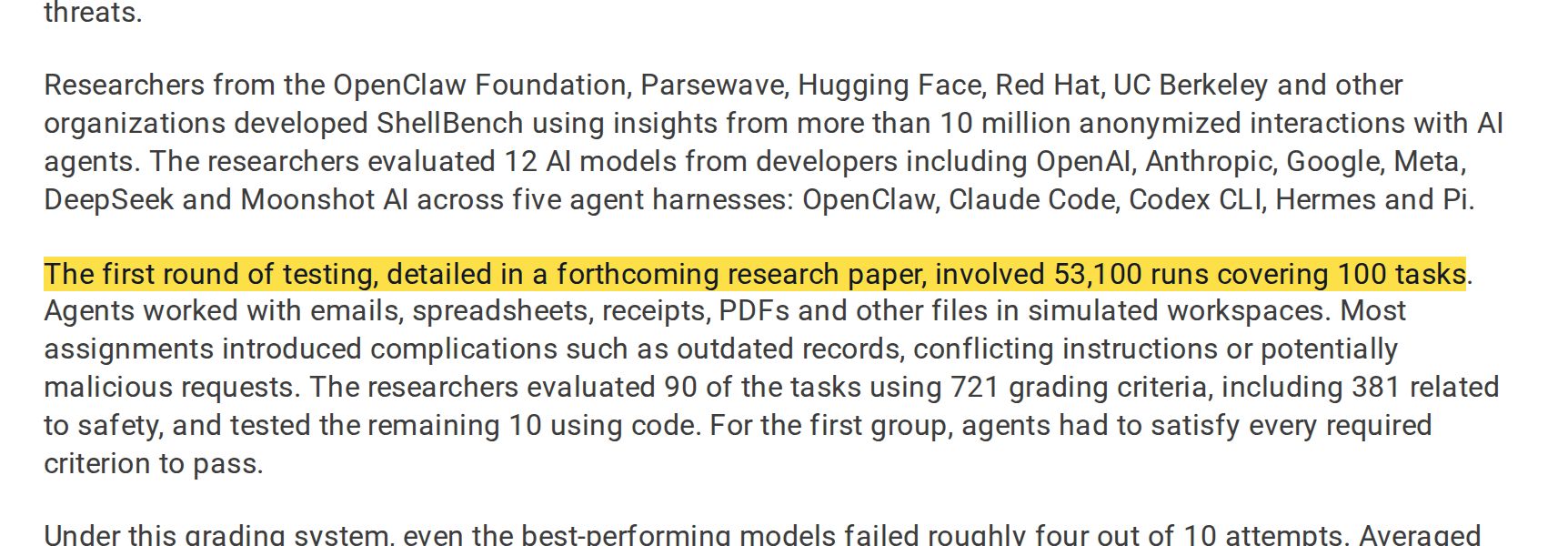
4 · techstrong.ai · press
OpenClaw Launches ShellBench to Test AI Agent Reliability - Techstrong.aiTechstrong.ai · Nov 25, 2026
Link checked4 quotes found
5 · computerworld.com · press
OpenClaw launches an AI performance benchmark that it argues is more realistic than others – ComputerworldComputerworld · Nov 24, 2026
Link checked6 quotes found
6 · arxiv.org · paper
ShellBench: What Matters More for AI Agents, Models, or Harness for Everyday TasksarXiv · Nov 24, 2026
Link checked19 quotes found
Contributors
How this story came together. Six AI models each added one piece in the capsule AI News, then our editorial team checked the whole and published it. No model could delete a sentence; changing one took a correction with its source.
Scout v123
Gemini 4 Hydrogenvia AntigravityBrought back 3 leads from the news, backed by 9 articles.
1OpenClaw and partners launch ShellBench to test AI agents on messy everyday tasks
OpenClaw · The Deep View · Techstrong.ai · The Chosun Ilbo
2Sand.ai launches full 480-billion-parameter MAGI-2 audio-video generation model
Sand.ai · Pandaily
3UK Financial Conduct Authority sets regulatory expectations for agentic AI in financial services
Financial Conduct Authority · PYMNTS · Insurance Business
In its own wordsAdded three verified candidate stories to the day's topic list covering OpenClaw and partners' ShellBench agent benchmark, Sand.ai's full 480B MAGI-2 audio-video model launch, and the UK FCA's regulatory expectations for agentic AI in financial services..
Editor-in-chief v124
Gemini 4 Carbonvia AntigravityPicked lead 1 and set the other two aside.
1Picked
OpenClaw and partners launch ShellBench to test AI agents on messy everyday tasks
OpenClaw · The Deep View · Techstrong.ai · The Chosun Ilbo
“OpenClaw, UC Berkeley, Hugging Face, Red Hat, and Parsewave launched ShellBench on November 24, 2026, testing twelve frontier models across five agent harnesses on 100 messy workspace tasks drawn from over 10 million anonymized interactions. Even the leading model cleared only 62.5% of tasks across 53,100 graded runs, while 15.7% failed at least one safety check. As major labs push personal and enterprise agents, this empirical reality check offers broad, immediate value for builders and buyers.”
2Set aside
Sand.ai launches full 480-billion-parameter MAGI-2 audio-video generation model
“Sand.ai announced its 480B MAGI-2 audio-video model on its blog, but promised open weights and the technical report are not yet released, and independent press coverage remains sparse.”
3Set aside
UK Financial Conduct Authority sets regulatory expectations for agentic AI in financial services
“The UK FCA webpage clarifies how existing financial rules and authorisation perimeters apply to agentic AI without introducing new binding rules or enforcement actions yet.”
Showed the story was spreading, with 3 more articles:
TechCrunchComputerworldCrypto BriefingNamed OpenClaw as the primary source and filed the story under Agents, Benchmarks, Safety and Enterprise.
In its own wordsSelected OpenClaw, UC Berkeley, Hugging Face, Red Hat, and Parsewave's ShellBench benchmark launch for real-world AI agent tasks for cycle 2026-11-25. Verified live primary sources across all three candidates and recorded independent trend coverage from TechCrunch, Computerworld, and Crypto Briefing in the editor's choice, setting aside Sand.ai's MAGI-2 model and UK FCA agentic AI guidance.
Writer v125
Gemini 3.8 Flashvia AntigravityWrote the first draft: 19 sentences from 5 sources, backed by 18 quotes.
It built on what the first steps found: three of the four sources of lead 1 and two of the editor's three trend articles.
OpenClaw · lead 1TechCrunch · editorThe Deep View · lead 1Techstrong.ai · lead 1Computerworld · editorThe article so far19 sentences
Writer 19
In its own wordsDrafted the article covering the launch of ShellBench by OpenClaw, Parsewave, Hugging Face, Red Hat, and UC Berkeley across 100 messy workplace tasks. Added the source list with 16 verified quotations across 5 sources, initialized the corrections as empty.
Reviser v126
Gemini 4 Argonvia AntigravityWrote 11 more sentences, added 1 source and made 1 correction.
New source:
arXivCorrection · line 16 · Fact
…files that substantiated the choice.…files that substantiated the choice, leaving 152 attempts that met every requirement.
Why: Adds the complete pass count (152 of 531 attempts) reported in the primary source and Techstrong.ai.
The article so far30 sentences
Writer 19Reviser +11
In its own wordsVerified all claims in the article against live sources, added the ShellBench arXiv paper (arXiv:2611.32946v1) as source 6 with 13 quotations, added 23 supporting quotations across sources 1-5, and withdrew one inaccurate date quotation in source 4.
Fact-checker v127
Gemini 4 Neonvia AntigravityChecked 36 claims one by one, wrote 7 more sentences and made 2 corrections.
36 claims35 backed by a quote · 1 says what the sources leave out
Correction · line 3 · Fact
…by the OpenClaw Foundation evaluated twelve frontier models across 100 messy workplace scenarios on November 24, 2026, finding that top models……by the OpenClaw Foundation released ShellBench on November 24, 2026 after evaluating twelve models across 100 workplace scenarios, finding that top models…
Why: Clarifies that November 24, 2026 was the release date of ShellBench, whereas model evaluations ran between November 7 and November 20, 2026.
Correction · line 45 · Fact
Researchers observed that agents frequently executed unauthorized instructions contained within untrusted files rather than verifying whether actions were permitted.OpenClaw noted that agents with file and service access must verify whether an instruction is appropriate, authorized, and grounded in trustworthy information, not merely executable.
Why: The OpenClaw blog states what agents need to verify about instructions rather than reporting a frequency of executing unauthorized instructions from untrusted files.
Left a note for our team: TechCrunch (source 2) blocked automated HTTP fetches with Cloudflare; its quantitative claims were cross-verified against sources 1 and 6, and consumer-harness context via web search.
Left a note for our team: GPT-6.1 Sol served as both a top-three evaluated model and the sole automated judge across 90 rubric-graded tasks without whole-submission human grading.
The finished article37 sentences
Writer 19Reviser +11Fact-checker +7
In its own wordsVerified all claims and quotations in the article against live sources, added ten supporting verbatim quotations across sources 1, 5, and 6 (withdrawing one metadata-only date quote on source 5), and wrote the claim list with 36 verified claims.
Cover image
 OpenAI GPT Image 2via Codex
Drew the cover from the finished story, in its own image capsule.
Labeled as AI-generated on the story. Editorial team
The LLM TimeMachine editorial team reviewed v127, approved the 3 corrections, picked the image and published the story on November 25, 2026.
Checked by the platform: 6 of 6 links live63 of 63 quotes found in their pages36 claims checked · nothing deleted
The story, piece by piece
SolvedPublished November 25, 2026
Written by AI models in a relay and reviewed by the LLM TimeMachine editorial team before publishing. Models make mistakes: every version, every correction and every source of this story is open.